Parte de Viajeros Spain 2026: How to Register Guests with SES.Hospedajes
The complete English-language guide to guest registration for vacation rental hosts in Spain. What changed, what you need, and what happens if you don't do it.
If you rent out a property in Spain — even just one apartment, even just for a few weeks a year — you are legally required to register every single guest with the Spanish authorities. This is called the Parte de Viajeros (traveler's report), and since late 2024, the system for submitting it has fundamentally changed.
This guide explains the current system as it works in 2026, in plain English. No legal jargon, no copy-pasted government text — just what you actually need to know and do.
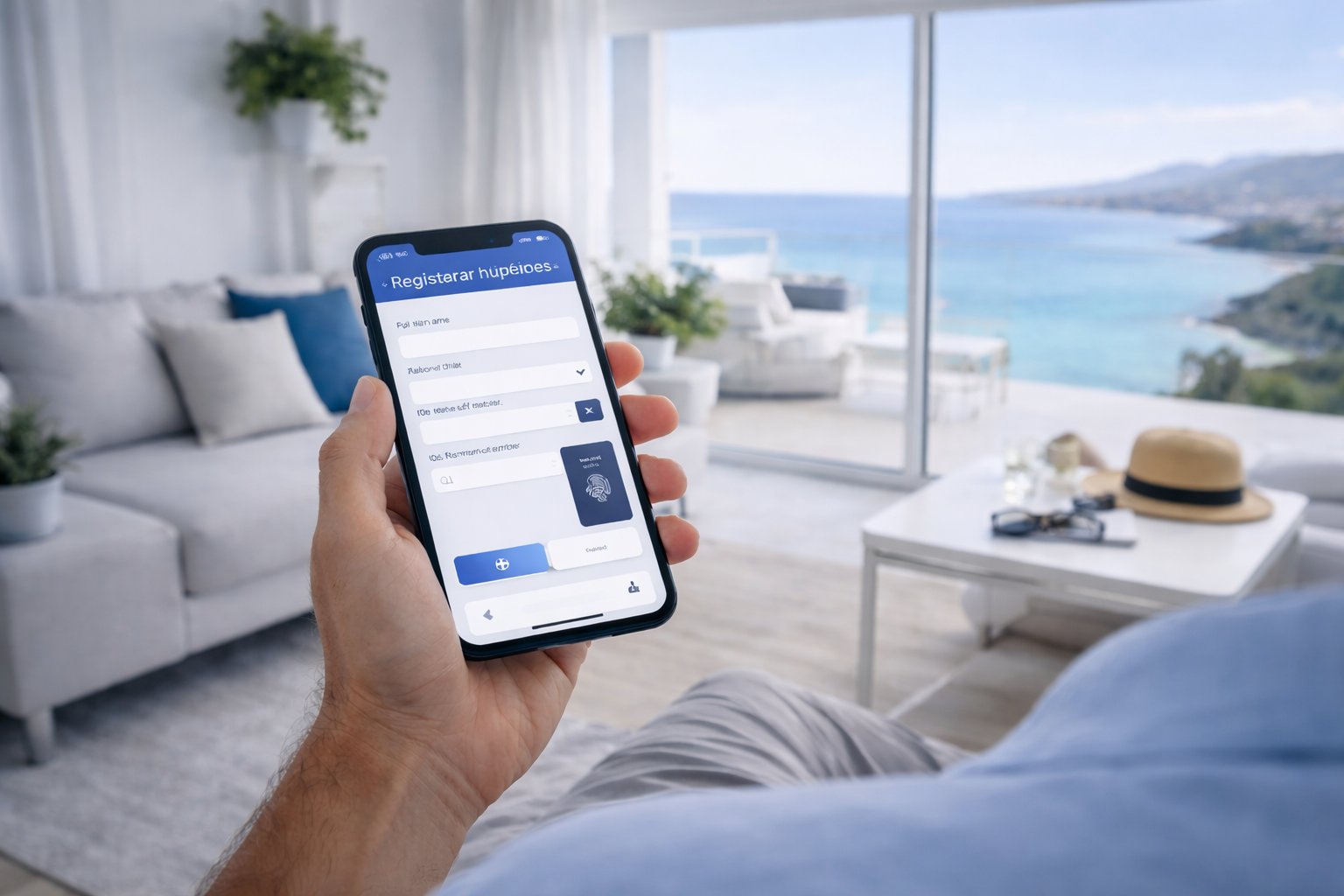
What Is the Parte de Viajeros?
The Parte de Viajeros is a mandatory guest registration that all accommodation providers in Spain must submit to the Ministry of Interior. It applies to hotels, hostels, campsites, and — yes — vacation rentals including Airbnb, Booking.com, and private bookings.
The purpose is security: Spanish law requires that authorities know who is staying where, and when. This has been the law for decades, but the enforcement and the system for submitting it have changed significantly.
This is not optional. Every host with a tourist license in Spain must register every guest. Failing to do so can result in fines starting at €600, going up to €30,000 for repeated violations. The Guardia Civil and Policía Nacional actively check compliance.
What Changed: The New SES.Hospedajes System
Until recently, many hosts submitted guest data by visiting the local Guardia Civil or Policía Nacional office in person, or via a basic online form. Some regions had their own platforms. It was inconsistent and confusing.
In late 2024, Spain introduced the SES.Hospedajes platform — a unified digital system managed by the Secretaría de Estado de Seguridad. This is now the standard method for all accommodation providers across Spain.
Key changes
- More data required. The new system asks for significantly more information than the old Parte de Viajeros, including payment method details and booking platform information.
- Digital only. Paper forms at the Guardia Civil are being phased out. The system is online.
- Stricter deadlines. Data must be submitted before check-in or within 24 hours of arrival.
- All guests, not just the lead booker. Every person staying at the property must be registered — adults and minors.
What Data You Need to Collect
For every guest (including children), you must collect and submit the following:
| Data field | Details |
|---|---|
| Full name | First name and surnames as on ID document |
| Gender | As stated on ID document |
| Date of birth | Day, month, year |
| Nationality | Country of nationality |
| ID document type | Passport, national ID card (DNI/NIE), or other travel document |
| ID document number | Exact number as printed on the document |
| ID issue date | When the document was issued |
| ID country of issue | Country that issued the document |
| Check-in date | Date of arrival at the property |
| Check-out date | Expected departure date |
| Relationship to lead guest | For accompanying guests (spouse, child, etc.) |
| Payment method | Card, bank transfer, cash, platform payment |
| Booking platform | Airbnb, Booking.com, direct booking, etc. |
For minors (under 18): You need the same ID information, plus the name and ID number of the accompanying adult responsible for them.
How to Access SES.Hospedajes
The platform is accessible at the Spanish Ministry of Interior's website. To get started:
- Register as an establishment. You need your tourist license number, your NIE/NIF, and your property details. Registration is done online through the SES platform.
- Get your access credentials. After registration, you'll receive login credentials for the platform. This can take a few days.
- Submit guest data. For each booking, you enter the required data through the web interface. Some property management systems (PMS) can submit directly via API.
The login options
- Certificado digital — the most reliable method. If you already have a Spanish digital certificate for tax purposes, you can use the same one.
- Cl@ve — Spain's digital identity system. Works if you're registered.
- Username/password — created during establishment registration.
Tip for non-Spanish hosts: If you don't have a certificado digital, getting one through your local Hacienda office or a gestoría is highly recommended. It unlocks access to SES, tax filing, and many other Spanish government platforms.
When to Submit
The official requirement: guest data must be submitted before check-in or within 24 hours of arrival. In practice, the safest approach is to collect the data before arrival and submit it on the day of check-in.
Practical workflow
- At booking confirmation: Send your guest a pre-check-in form requesting their ID details. Many hosts include this in their booking confirmation message.
- Before arrival: Enter the data into SES.Hospedajes. This way you're covered even if the guest arrives late.
- At check-in: Verify the ID document matches the submitted data. Take a photo of the ID for your records.
Pro tip: Collect passport/ID photos via WhatsApp or a simple online form before arrival. This saves time at check-in and ensures you meet the deadline. Guests are used to this — hotels do the same thing with online pre-check-in.
What Happens If You Don't Register
Let's be direct about this. Some hosts skip registration because it's tedious, because they don't understand the system, or because they think small rentals fly under the radar. Here's what actually happens:
- Random checks: The Guardia Civil visits properties and asks to see your registration records. This happens more often in tourist areas along the coast.
- Platform data sharing: Airbnb, Booking.com, and other platforms share booking data with Spanish tax authorities. If you have bookings but no guest registrations, it's a red flag.
- Fines: Starting at €600 for a first offense. Serious or repeated violations can reach €30,000. Operating without any registration system is treated as a serious infraction.
- License issues: Non-compliance with guest registration can be grounds for revoking your tourist license.
Don't assume you won't get caught. Enforcement has increased significantly since the new SES system was introduced. The digital system makes it much easier for authorities to cross-reference bookings with registrations.
Common Mistakes to Avoid
- Only registering the lead guest. Every person staying at the property must be registered, including children. A family of four means four registrations.
- Forgetting same-day bookings. Last-minute bookings through Airbnb still need registration. Have a process ready.
- Incorrect ID numbers. Typos in passport numbers are the most common error. Double-check the data before submitting.
- Not keeping records. Keep copies of submitted registrations and guest ID documents. You may need them if the authorities request proof.
- Assuming your PMS handles it. Some property management systems claim to handle Parte de Viajeros automatically. Verify that they actually submit to SES.Hospedajes — not all of them do.
Making It Easier: Practical Tips
Guest registration is tedious but it doesn't have to eat your time. Here's how experienced hosts handle it efficiently:
- Create a pre-check-in form. Use a simple Google Form or Typeform that collects all required data. Send the link with your booking confirmation. Most guests fill it in within a day.
- Template your messages. Have a standard message ready that explains why you need the ID data and makes it easy for guests to submit. Normalize it: "As required by Spanish law, we need the following details before check-in..."
- Batch your submissions. If you have multiple check-ins per week, set a daily routine — 10 minutes each morning to submit any pending registrations.
- Use your guest communication tool. If you use an AI guest assistant like PropertyHost, you can integrate the pre-check-in data collection into your automated guest journey. The guest receives the request at the right time, in their language, without you sending it manually.
Frequently Asked Questions
Do I need to register guests if I don't have a tourist license?
If you're renting without a license, you have bigger problems — operating without a tourist license carries its own fines (€3,000-€30,000+). But technically, the guest registration requirement applies to all accommodation providers, licensed or not.
What about guests who refuse to provide their ID?
You cannot legally accommodate guests who refuse to provide identification. This applies to all accommodation in Spain, including hotels. If a guest refuses, you must decline the booking.
Do I need to register Spanish guests too?
Yes. The requirement applies to all guests regardless of nationality — Spanish citizens, EU residents, and non-EU visitors alike.
What if my guest arrives late and I'm not there?
This is exactly why collecting data before arrival is essential. If you have the information pre-submitted, the guest's late arrival doesn't affect your compliance. For self-check-in properties, a pre-check-in form is practically mandatory.
Can my property manager handle this for me?
Yes. If you use a property management company, they can submit registrations on your behalf. Make sure this is explicitly included in your management agreement, and verify they're actually doing it.
The Bottom Line
The Parte de Viajeros is non-negotiable if you host in Spain. The new SES.Hospedajes system is more thorough than the old paper forms, but it's also more organized. Once you have a workflow — pre-check-in form, timely submission, proper records — it becomes routine.
The hosts who get this right from the start avoid fines, keep their license, and build a sustainable rental business. The ones who ignore it are playing a game they will eventually lose.
Compliance isn't glamorous, but it's the foundation of a serious hosting business. Get the boring stuff right, and you can focus on what actually matters — giving your guests an amazing experience.

Automate your guest journey
PropertyHost handles guest communication from pre-arrival to checkout — including pre-check-in data collection. In 12+ languages, automatically.